


An ambitious strategy which aims to bring the wild salmon population in Scotland back from crisis point has been launched.
Atlantic salmon is an iconic species featuring highly among the wildlife readily associated with Scotland at home and abroad.
Loch Lomond and its tributary rivers, the Leven, Fruin and the Endrick, are famed for salmon fishing.
Salmon are affected by a wide range of pressures, some at sea, but many others acting within the Scottish freshwater and coastal environments. A key contributory factor appears to be climate change.
The strategy highlights five priority themes for action, including improving the condition of rivers, managing exploitation including the effectiveness of deterrents to poachers, understanding and mitigating pressures salmon face in the marine and coastal environment, international collaboration and developing a modernised policy framework.
Each theme is matched with a range of measures which will combine to address the many challenges salmon face in their lifecycle.
The strategy also signals an increase in efforts to build up resilience of salmon stocks through partnership working across public, private, and civil society groups.


Rural Affairs Secretary Mairi Gougeon, pictured left, said: “I am grateful to the many organisations which have contributed to development of this important and ground breaking strategy for wild salmon in Scotland.
“There is now significant evidence showing that populations of Atlantic salmon are at crisis point and, we must now reinvigorate our collective efforts to ensure a positive future for the species.
“Although the pattern of decline is repeated across the salmon’s North Atlantic range, with climate change a significant factor, there remains much that we can do in our rivers, lochs and coastal waters to seek to build resilience and transform the fortunes of this iconic fish.
“In addition to the measures we will take in Scotland, we are committed to supporting and pushing forward collective action in the international arena, so the young salmon leaving our rivers survive the many challenges they face on the high seas to return to their home river to spawn the next generation. Only by acting together, at home and overseas, and applying our collective resource, knowledge and expertise can we hope to change the fortunes of this iconic and vital species.”
Read the Wild Salmon Strategy.
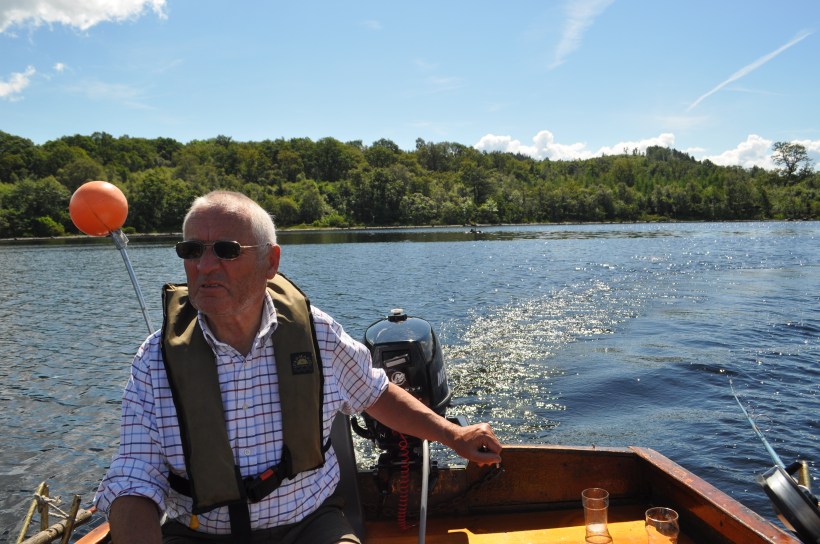

Gone fishing – local angling author Dick Dickson trolling for the king of fish on Loch Lomond.
Scotland is a stronghold for salmon, which start their lives in streams and rivers, migrate to the high seas to grow and return home to spawn, connecting diverse habitats over a vast area.
Salmon live in fresh water for 1-4 years before undertaking a long migration north to their feeding grounds in the North Atlantic. After 1-3 years at sea, adults often return to the river in which they were hatched to spawn and begin the next generation.
This life cycle means they are exposed to a range of threats and pressures in streams, rivers, sea lochs, estuaries, coastal waters and the open ocean.
The number of salmon returning to Scotland’s coast has declined since the early 1970s. The estimated number of spawning salmon remained steady over this period, before declining from 2010 onwards.
Meanwhile, fishermen have reacted angrily to new measures being introduced by the Scottish government to protect cod stocks in the Firth of Clyde.
The government is to end exemptions allowing langoustine trawlers, creels and scallop dredgers to use the area during the approaching spawning season.
The Clyde Fishermen’s Association said the decision would have “a horrific impact” on local fishing families.
Ministers acknowledged it would have a short-term impact on local fishers.
But the government added that “taking action now” to try to replenish cod stocks for the longer term was “ultimately beneficial” for fishing.
For the past two decades, measures to protect spawning cod in the Firth of Clyde have been in place through an annual 11-week seasonal closure between 14 February and 30 April.
The Clyde Cod Box closure – which was supported by fishermen’s groups – targeted net fishing of cod. But there were exemptions to allow bottom contact fishing, be it static/creel fishing or mobile fishing, on the grounds that low numbers of cod were being caught.
The government said that despite this, the stock had shown little sign of recovery, and therefore the exemptions must end.


In a strongly-worded statement, the Clyde Fishermen’s Association said: “This decision will have a horrific impact on the fishing families of the Clyde, and we are struggling to identify the reasons for this action.
“This will mean a total loss of income for many of the small family boats for months.
“This is not a burden they can easily bear as these fishing communities have already had the hardest two years they can recall between Brexit and Covid.
“Some families may sell up and relocate, families can’t survive for months with no income.
“This will impact not only the fishing economy, but also the wider socio-economy of fishing villages, towns and their facilities such as shops and schools.”
Blunt approach
One conservation charity welcomed the move, saying the Scottish government had “righted a long-standing fault in fisheries management in the Clyde”.
“For years, bottom-towed fishing has risked damage to areas of seabed which are essential for the recovery of Scotland’s collapsed west coast cod stocks,” Phil Taylor, head of policy at Open Seas, said.
He added: “The government’s approach here is a blunt one – banning all fishing activity. Sustainable fishing can continue alongside recovery measures if well-managed.”
The Scottish government said the new move “aligns with commitments in the policy programme of the Bute House Agreement between the Scottish government and the Scottish Greens and our shared aim to restore marine habitats in Scotland’s inshore waters”.


A spokesman added: “During spawning, cod are extremely vulnerable to any activity impacting the seabed and limiting physical disturbance during the spawning period will minimise disruption to the spawning environment and promote cod reproduction.
“We appreciate this will have a short term impact on local fishers, but taking action now to try to replenish the stock for the longer term is ultimately beneficial for fishing as well.”
The Scottish Greens welcomed the change.
Environment spokesman Mark Ruskell said: “Fisheries protection must be led by the science, and its clear that this decision is the right one if we are to recover cod populations and protect our environment.
“For too long fish stocks have been allowed to decline and destructive practices like trawling and dredging have been allowed to cause damage in an area that is supposedly closed during the spawning season for the benefit of cod conservation.”