


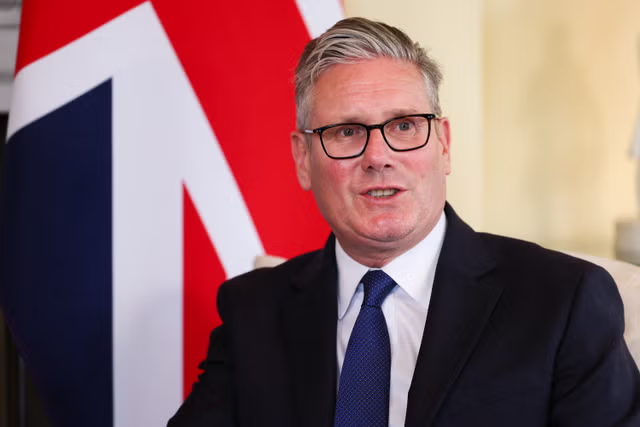
When Downing Street wants to seize the news agenda, its staff call in political reporters for a scripted speech by the prime minister. It is an advantage of power: the ability to drag out a lectern bearing the UK government’s official seal and command attention.
Keir Starmer had spent days hiding from a febrile Westminster press pack eager to grill him about the scandals surrounding Peter Mandelson. But on Monday morning, the British prime minister blew all of that away – for now – at a hastily arranged media gathering.
Starmer strode onstage in the briefing room in number 9 Downing Street and, gripping the lectern, steered the agenda back to the ground that has felt firmest for him recently: obliquely telling US president Donald Trump that he is on his own in the war against Iran.
“We will not be drawn into the wider war,” he said, his staff emphasising in italics in the official written account afterwards this snub of Washington, after Trump had asked Starmer for military help.
“Our priority is always the national interest,” said the PM. British national interest, of course.
On a couple of occasions, Starmer even appeared to rename the US president “some”.
“I have been attacked by some for my decision not to join the offensive against Iran,” said Starmer, warming to his theme of geopolitical independence. “But at every stage, I have stood by my principles … Principles I believe are shared by the British people.”
He appeared to criticise Britain’s decision to follow the US into the ruinous Iraq War in 2003, echoing another popular contemporary position in the Labour Party. I won’t make the same mistake, he appeared to say.
“My leadership is about standing firm for the British interest … No matter the pressure [from some] … I believe time will show we have the right approach.”


Starmer said he had spoken to Trump on the phone on Sunday. The US president wants Britain’s military help to forcibly reopen the Strait of Hormuz, a narrow shipping channel near Iran through which one-fifth of the world’s oil supplies normally pass, and which Iranian forces have effectively closed in recent weeks by attacking merchant ships.
Starmer revealed he was working, not with Trump, but with the leaders of other European countries on a potential plan for reopening the strait. He suggested it could involve using mine-hunting technology to remove Iranian munitions from the water.
But he gave no hint that Britain would, as Trump has been loudly demanding, send its navy to escort ships. That would risk direct military engagement with Iran were the Islamic regime to target passing British military vessels.
On the domestic front, Starmer announced £53 million (€61 million) to help cushion the blow of energy price inflation for British homes that rely on home heating oil. UK retail energy prices were already due to be capped for three months.
Britain’s king Charles is due to go on an official state visit to the United States towards the end of next month. Starmer seems to be gambling that the US president, a fan of monarchy, may limit his criticism of Britain so as not to overshadow the king’s visit.
The formal Britain-United States “special relationship” may not be dead yet. But the Trump-Starmer bromance is.
Top picture: A Royal Navy mine hunter which could be used to help clear the Strait of Hormuz which Iran has blockaded.