


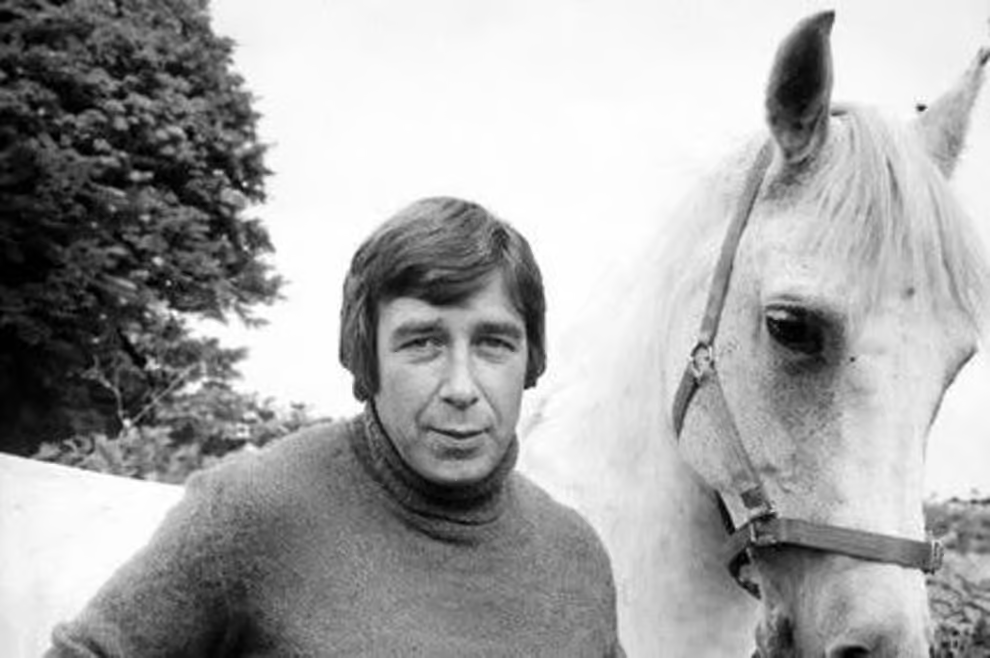
Outside of journalism, Frank Hurley’s passion was the countryside
Obituary: Frank Hurley, journalist who meted out justice as The Judge
Frank Hurley, who has died aged 81, was arguably one of Scotland’s most powerful journalists, winning compensation for hundreds of readers as “The Judge” whose weekly column in the Sunday Mail exposed fraudsters, crooked car dealers and dodgy salesmen.
Many of his two million readers were convinced that they were complaining to a real judge – the scales of justice atop the Old Bailey featured prominently above his column every week.
But in fact it was Frank Hurley dispensing his uncompromising verdicts against businesses and individuals who deserved to be named and shamed.
Along the way he wrote a touching autobiography, The Boy in the Trenchcoat, about his grim post-war upbringing in South London which received rave reviews in national newspapers thanks to the proprietor of the Daily Mail and Mail on Sunday, Lord Rothermere, whom Frank had befriended when the then apprentice Jonathan Harmsworth had trained as a reporter on the Sunday Mail.
His Lordship, grateful for Frank’s assistance and advice during those early days in the cut and thrust of Glasgow newspapers, helpfully ensured that the book was well publicised – and the sales soon boomed.
His mother hated the blitzed urban landscape of London and longed for home.
So she would take Frank, his older sister and younger brother back to Scotland for extended family visits – the four of them very often hitchhiking.
“My mother would try all sorts of tricks. Sometimes we would get the train and she would buy a ticket for herself. Then we would hide when the guard came round. We were always seesawing between Scotland and Croydon.”
It was during these visits to Scotland that Frank developed his love of nature, animals and the countryside, the freedom of playing in open fields, catching trout and eating freshly farmed food. It was a vey different life compared to the desolation and rationing in London.
There were times when the family had to live in hostels for the homeless until they eventually moved to New Addington, a newly built council estate isolated from the rest of Croydon. There were no trams, few bus links and no pavements. Money was tight and Frank remembers stealing flowers from neighbours’ gardens to sell in the local market and digging manure to be sold locally as fertiliser.
But his childhood memories and longing for Scotland encouraged him to move to Edinburgh, where he became a feature writer on the city’s Evening News which, in the early 1970s, sold 150,000 copies every afternoon.
Frank bought and extended a stone cottage with some land at the foot of the Pentland Hills and pursued a country life of riding, shooting and fishing, complete with a horse named Tinsel.
Later, he and his family moved to a sprawling farmhouse with land by the small hamlet of Wiston in Lanarkshire, where he bred Jack Russell terriers and enjoyed the role of a country squire.
His talent was spotted by the Scottish Daily Express but, after only a few months of working there in 1974, the paper was dramatically downsized, its imposing Glasgow headquarters in Albion Street was abandoned and the majority of editorial staff were made redundant as the printing operation moved to Manchester.
After a period as a freelance reporter, Frank joined the Sunday Mail in 1978, working in the state-of-the art Anderston Quay building adjacent to the Kingston Bridge in Glasgow housing Europe’s first daily newspaper colour printing presses which, with the demise of the Express, propelled the Daily Record and Sunday Mail to circulation heights of around 800,000 sales a day.
By the early 2000s, as newspapers began to suffer significant falls in circulation followed by cost-saving redundancies as the internet and social media took over, Frank Hurley ended his 45-year reporting career working freelance again and contributing to the now defunct weekly The Glaswegian, where he passed on his knowledge and experience to trainees.
He is survived by his wife of 12 years Margaret and by his children Ryan, Leigh and Luke from his previous marriage to Louise, and four grandchildren Mason, Ethan, Ivie and Freyja.