


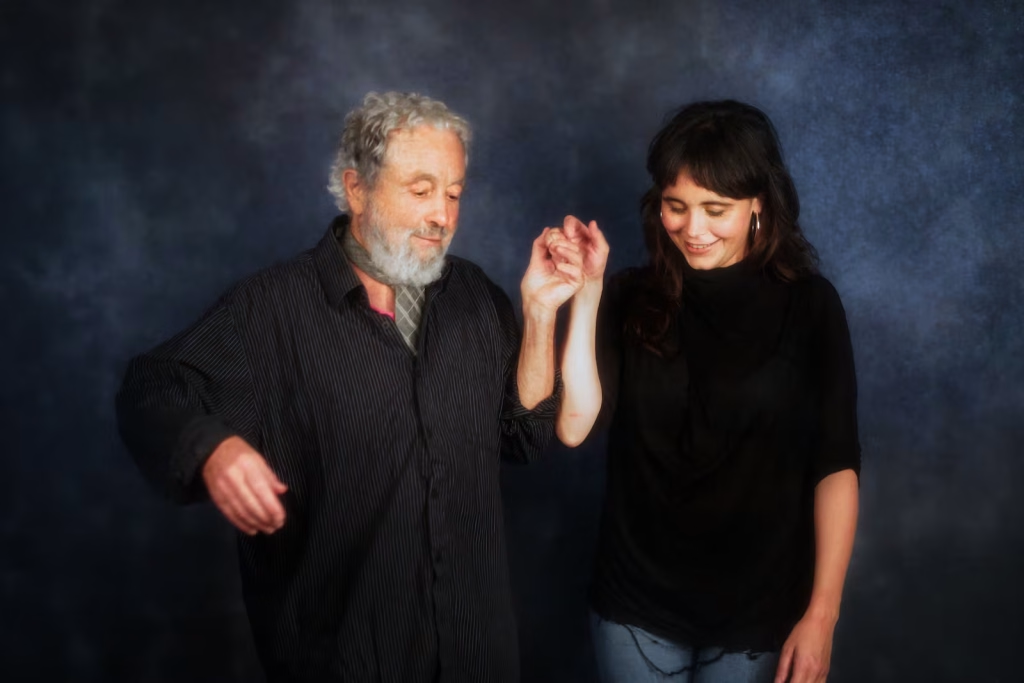
A Wild Inhabitation: Antoni O’Breskey and Consuelo Nerea Breschi
To mark his 50th year in music, Antoni O’Breskey has made the album A Wild Inhabitation with his daughter. It draws on all they’ve learned through decades of cultural melding


The lifeblood of traditional and folk music lies in the ties that bind singers and musicians to one another, the often invisible threads allowing melodies and lyrics to flow from one generation to the next. The most creative recognise the inheritance while still making the music their own.
At its best it’s a gloriously porous world, alive to external influences that can breathe fresh life and ideas into the tradition. Where would we be if Andy Irvine hadn’t travelled the Balkans in the 1960s, returning with the most intricate rhythms from Bulgaria?
And what of the riches of the so-called Child ballads, which the Harvard professor Francis James Child gathered in England and Scotland in the second half of the 19th century, and which wended their way into the repertoires of Elizabeth Cronin, Mary McPartlan and Planxty?
Countless Irish musicians have collaborated fruitfully with an enigmatic Italian musician of Argentinian heritage who has been living here for many decades. Antoni O’Breskey – he altered his name from the original Antonio Breschi to make it more manageable for us monoglots – has a deep love of myriad musical forms, from jazz to folk and flamenco, and he has unearthed fresh perspectives on Irish traditional music through his piano and the many other instruments he plays, which include trumpet, dulcimer, clavichord and spoons.
O’Breskey’s nomadic sensibilities have been at the heart of both his personal life and his musical life, and those travels are writ large in the tunes he has chosen for this latest collaborative project, which also features the cellist Kevin Murphy and the fiddle player Ultan O’Brien among a raft of other musicians.
So I call home where I feel at home, because in the country where I was born, especially in the city called Florence, I was often not feeling at home.
“There is a missing meaning in the Italian language. The difference in meaning between the word ‘home’ and the word ‘house’ in Italian has ceased to exist. Now it’s just called ‘casa’, which refers to a physical house.
It’s always important to give hope in the music and not to separate the joy from sadness, because that separation is always wrong, and it is useful for the power[ful], such as separating the old from the young, or the immigrants from the citizens
— Antoni O’Breskey
“But, for me, a physical house doesn’t mean anything. You can own a castle or 200 houses and you don’t necessarily feel at home. On the other hand, even if you don’t own any houses, such as people who are living on the streets, they are often feeling at home better on the streets than in a house.”
Travel still fuels O’Breskey’s sense of himself, enabling him to embark on rich inner journeys.
“The place where I first felt most at home was Alabama, and then Greece – an incredible adventure,” he says. “I went to Greece with €30 in my pocket, and I travelled all [over], exchanging my music for Greek hospitality.
“I have never been a tourist. I have been a traveller who always exchanged my music for hospitality. Once in my home, on the last day of the year, we say ‘happy new year’ in 16 different languages. I felt at home when I could bring people together, especially children.
“I always sang and played on the streets in many countries,” O’Breskey says. “But these travels are not only exterior. They are also interior, in myself. And this interior travelling is very strong. I travel all of the time inside myself to find the proper inhabitation that makes me feel at home. It is not a coincidence that this new album is called A Wild Inhabitation.”
This album is full of heart, a thoughtful and often meditative collaboration with his daughter,
Consuelo Nerea Breschi, who refers to the album as an intergenerational dialogue, is a singer, bodhrán and fiddle player, and member of many bands, including The Morning Tree, Varo, Landless and, most recently, Rattling Ark.
She came late to music, having focused her energies elsewhere before moving to Ireland from Italy.
“I grew up in this amazing house in the countryside in Tuscany which was a centre for musical exchange from all over the world. It was a big house, and musicians would come from all over the world. We’d have half of De Danann, half of The Dubliners, Andy Irvine and Dolores Keane, and then we’d have gypsy flamenco guitarists, an orchestral director from Morocco, an Iranian percussionist. The list could go on and on.


“They could stay sometimes for weeks or for months, so this environment was very important for me. I think I absorbed a lot from this beautiful exchange of cultures. Then I felt a strong need to start playing myself, and after a few years I felt I needed to find something similar, and I moved to Ireland in 2014, which was the beginning of the folk revival of my own generation. I loved this exchange of cultures, of genres and of experimentation.”
Breschi brings a certain baroque quality to the album. She is a long-time admirer of the singing of Eithne Ní Uallacháin, Sandy Denny, June Tabor and Joan Baez – a reflection of the eclecticism that coloured her upbringing and now fuels her own musical decisions.
“In my song choices you can see my early listening,” she says, “with January from Dolores Keane, Blackwaterside from Anne Briggs and an unusual version of Lowlands of Holland that Martin Carthy sings, which is one of the most heartbreaking anti-war songs. Month of January and Blackwaterside are both about abandonment, told from the female perspective.”
The centrepiece of A Wild Inhabitation is Catharsis, a fittingly titled confluence of influences and ideas that exemplifies O’Breskey’s all-embracing musical philosophy.
“I often say that in Ireland a funeral is three days of celebration and it seems like a wedding. In Italy the weddings are three hours of boredom and it seems like a funeral.
“So for me it’s always important to give hope in the music and not to separate the joy from sadness, because that separation is always wrong, and it is useful for the powerful, such as separating the old from the young, or the immigrants from the citizens.
“The word ‘catharsis’ comes from the Greek word tragodia/tragedy. The meaning of this word has completely changed today. Tragedy today means something very sad, dark, and desperate, but the original meaning was the complete opposite. Tragodia was the transformation of death into life.”
A Wild Inhabitation is available from Bandcamp