

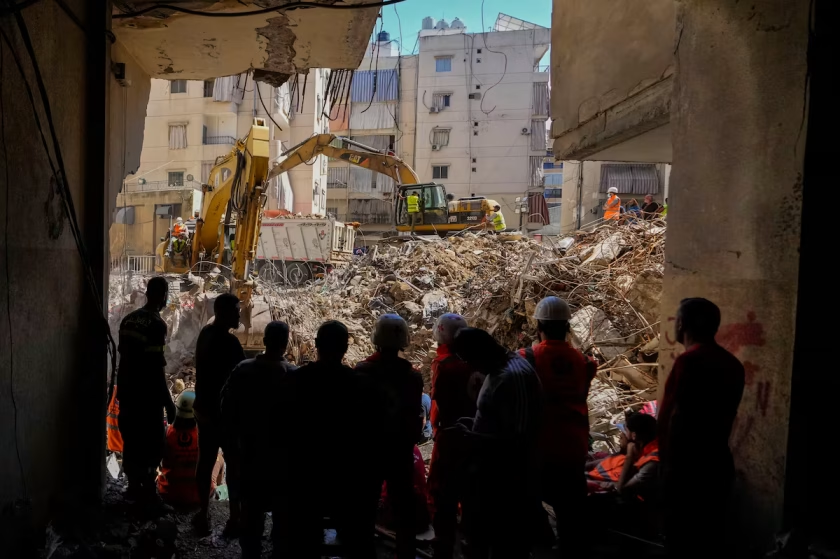
EU foreign policy chief Josep Borrell says ‘if this is not a war situation, I don’t know what you would call it’

After almost a year of war against Hamas in Gaza on its southern border, Israel is shifting its focus to the northern frontier, where Iran-backed Hizbullah has been firing rockets into Israel in support of Hamas.
The Israel Defence Forces (IDF) said fighter jets attacked more than 1,300 Hizbullah targets including missiles, launchers, drones and buildings where it said the Iranian-backed group had concealed rockets.
The European Union’s foreign policy chief Josep Borrell said that the situation is almost a “full-fledged war”.
“If this is not a war situation, I don’t know what you would call it,” he said, citing the increasing number of civilian casualties and the intensity of military strikes.
Borrell said efforts to reduce tensions were ongoing, but Europe’s worst fears about a spillover were becoming a reality.
[Full Israeli invasion of Lebanon could see Irish troops at heart of fighting]
Earlier, the IDF made 80,000 calls to residents of Shia areas in southern Lebanon urging them to leave their homes in areas where it said Hizbullah stores weapons. In the afternoon similar messages were sent to residents of the Bekaa valley, much further north, where Israel believes most of Hizbullah’s arsenal of long-range rockets are stored.
Huge traffic jams developed on the coastal road between Tyre and Beirut as tens of thousands of residents fled southern Lebanon.
On social media, Lebanese people shared appeals for, or offers of, cheap or free accommodation, with online forms set up to connect people with those willing to host them.
Relatives and friends sent advice over WhatsApp on what to stockpile – rice, gas, bulger wheat, water – while neighbours had similar conversations in the streets. Petrol stations saw queues of cars, their drivers filling tanks with fuel.
Lebanese schools will be closed on Tuesday as the country, already close to economic collapse with state-run institutions barely functioning and widespread power cuts, faces an internal refugee crisis.
An Israeli strike in Beirut’s Dahiyeh neighbourhood on Monday night targeted senior Hizbullah commander Ali Karaki, the head of the southern front, and considered number three in the group’s hierarchy. He was reportedly wounded.
Hizbullah fired more than 200 rockets and drones towards Israel, including at the country’s third-largest city, Haifa. Some projectiles also landed in the northern West Bank. No one was killed in the attacks but residents of northern Israel were told to stay close to bomb shelters at all times.
Israel’s government on Monday night declared a “special state of affairs” throughout the country, expanding the IDF’s powers to issue instructions to the public, such as a ban on gatherings and limiting studies.
An Israeli military official said Israel is focused on aerial operations that are aimed at curbing Hizbullah’s ability to launch more strikes into Israel. Some estimates said half of Hezbollah’s vast rocket arsenal may have been destroyed.
Iran’s president Masoud Pezeshkian accused Israel of seeking a wider war in the Middle East and laying “traps” to lead his country into a wider conflict.
- Sign up for push alerts and have the best news, analysis and comment delivered directly to your phone
- Join The Irish Times on WhatsApp and stay up to date
- Listen to our Inside Politics podcast for the best political chat and analysis

Mark Weiss
