

Planning authorities within local authorities are able to regulate the development of shops, including the creation of new shops.
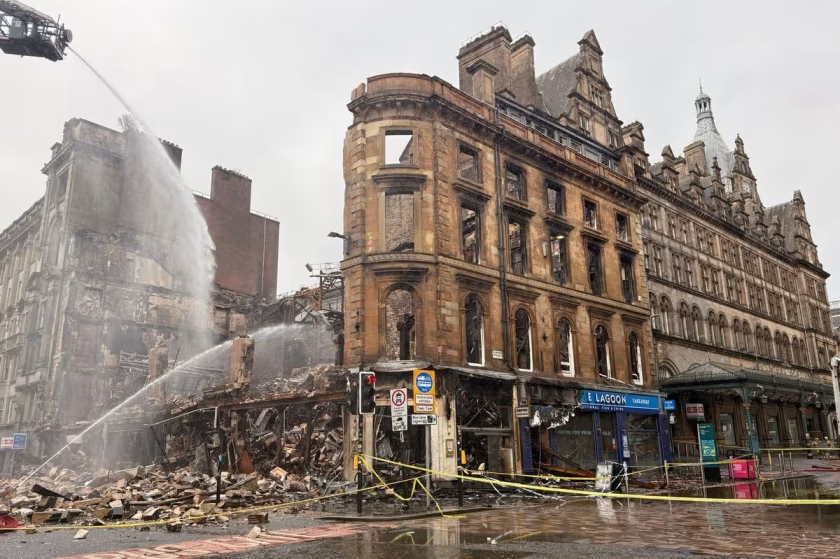
But there is nothing they can do to halt the sale of vapes, against which there has been a public outcry since the major fire which destroyed the Union Street/Gordon Street corner buildings in Glasgow.


Marie McNair MSP and Minister Maree Todd on the dangers of vaping.
West Dunbartonshire MSP Marie McNair has been told that changes to the specific range of goods that are sold in an existing shop do not constitute development, so they are not within the scope of planning control.
However, Scotland has a tobacco and vape retail register, and all businesses must be registered to be able to sell those products in Scotland.
It is the responsibility of local authorities to enforce compliance with the register in their local areas, and it is already illegal to sell all such products to under-18s. The registration process means that illegality can be stamped out.
The Scottish Government is now taking action to tackle vaping among young people.
In its first 100 days in government, we will consult on the retail display of vapes in order to remove the appeal and visibility of vapes to young people.
Under the Tobacco and Vapes Act 2026, offences on the free distribution and nominal pricing of vapes will come into force on 29 October this year. From 1 June 2027, a comprehensive ban on advertising vapes will come into force, which will reduce young people’s exposure to vape adverts.
They are taking forward substance use education work in our schools through the Curriculum for Excellence.
And young people are learning about a variety of substances, including vapes, and information is available through the Young Scot, Parent Club and NHS Inform websites.
Marie McNair told MSPs: “I recently met one of my constituents to discuss her concerns about underage vaping. We both agree that vapes should be stored like cigarettes, with no colourful marking or flavours available, to make them much less appealing. I am aware of the cross-governmental work on the issue.”
Ms McNair asked for ministerial backing and a progress update on that before asking what more can be done to ensure that vapes are not available to those who are underage.
“We will consult on the retail display of vapes within our first 100 days in government. We are working closely with the Society of Chief Officers of Trading Standards in Scotland to strengthen the enforcement of existing legislation that bans the sale of vapes to those who are under 18, including through checks on the age of sale, alongside providing guidance and support to businesses.”
It is not the vape product for sale that was the Glasgow fire problem. Rather it was a premises fire safety issue.
The fire that was started by a vape could have been caused by a mobile phone, a laptop computer, an overloaded socket, a sandwich maker, or in fact all manner of objects.
Young people taking up vaping is however another issue altogether. Vaping is most probably very substantially less harmful than smoking so in that respect it is good for those who would otherwise smoke. One cannot however imagine that vaping is actually good for people and for that reason it is probably a good thing to discourage young people from taking vaping up. But sadly, the fire issue as this article brings out has been conflated by the politicos with the issue of discouraging vaping in the young.
It might however be a suggestion to ask our politicians to consider why alcohol free, or 0.5% abv beers and lagers cost more than alcoholic lagers. Beers and lagers over 1.2% but below 3.4% abv have a pro rata levy of around £10.00 plus VAT on the price. This tax rises to around £20.00 plus vat pro rata on beers and lagers of strength between 3.5% and 6.8%. This adds something around £0.41 to £1.20 per litre on average depending on strength.
So how come the very low to no alcohol beers are more expensive than alcoholic beers. It’s cheaper to drink alcoholic beers – and don’t tell me that the cost of making a reputable brand of 0.5% abv costs more than its 4% identical counterpart. Maybe our politicos could consider this when they get all frothed up about health. Or are they in the pockets of big business out to rip as much as they can selling healthier beer.
And while I am at it how many of us have noticed that if you want to by a can of beer the minimum that you can buy is four cans. Not exactly a health incentive when you have to buy four when you maybe only wanted one or two. Not heard a cheep from our politicos about this either.
Two issues, major issues, and something that without doubt discourages reduced alcohol consumption. Maybe something for our politicos to consider – and I ask this of all the politicians quoted in this article.