


Queen Elizabeth University Hospital (top of page) , the Royal Children’s Hospital, Vale of Leven Hospital, Dumbarton and Alexandria health centres, and the Royal Alexandra Hospital, all part of the NHS.
by BILL HEANEY
 Councillor Jim Bollan, of the Community Party, commented: “The Court’s decision against the way the Standards Commission operates is an important matter and one that does not surprise me. The previous CEO of WDC, Joyce White, reported me on quite a few occasions to the SC, and I always believed she was trying to censor my right to free speech in doing so.
- Culture of Suppression: Dr. Kennedy, pictured on the right, noted that clinicians who attempt to sound the alarm about safety concerns frequently have their characters challenged and experience severe setbacks in their careers.
- The Two-Tier System: Highlighting a growing health divide, Dr. Kennedy warned that the service is “dying before our eyes,” forcing those who can afford it to go private while others are left “languishing” on lengthy waiting lists.
- Public Sentiments: Recent BMA polling indicated that 29% of Scots have used private medical care over two years, with 64% of those individuals citing excessive NHS waiting times as the primary reason.
 Health Secretary Angela Constance, left, firmly rejected the claims, stating that the allegation of health boards putting reputation first is “simply untrue”. She maintained that the Scottish government works closely with NHS boards to prioritize patient safety and support the healthcare workforce.
-
land’s patient safety commissioner Karen Titchener had a similar view. Although she said she could not make sweeping statements about all health boards, in her experience “it would appear” reputation was placed above patient safety and there was a “‘nothing to see here’ culture”.
Health boards, she said, sometimes turned on patients when they made complaints.
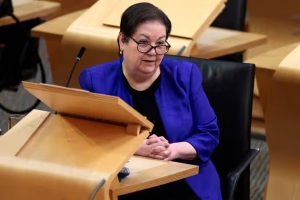 Commenting as Patient Safety Commissioner Karen Titchener and BMA Chair Iain Kennedy raise concerns about transparency in Scotland’s NHS, Dumbarton MSP and Scottish Labour Health spokesperson Jackie Baillie, right, said “These damning comments show NHS patients and staff are being let down on the SNP’s watch. We have seen the SNP’s culture of secrecy and cover-up time and time again in our NHS – from the scandal at the QEUH to the handling of complaints about Sam Eljamel in Dundee.
“Patient safety must always come first – not the reputations of Health Boards or government. It is reckless for the Health Secretary to dismiss these serious warnings. We need urgent action to ensure hospitals across the country are safe and a meaningful culture change to put openness, transparency and accountability at the heart of our NHS.”

Karen Titchener said there needed to be more accountability in the NHS
“Time and time again, and I would say with the majority of our stories, the patients just shut down, and they’re not listened to,” she said.
“They’re even seen as a pest and an aggressive patient when they’re trying to bring up something when they feel that harm was caused to them.
“That’s the concern – we should be putting the patients first, and we should be saying, ‘somebody’s raising a concern or saying, look, this is how my care happened’.
“If they’re just being dismissed, then that’s very concerning, because how can we change care if patients’ concerns are being dismissed?”
Titchener added that there needed to be a culture change which “has to come from the top”.
She added: “We all have to be open and transparent, but also we’ve got to start taking accountability for what goes on.”
Constance said she took a zero-tolerance approach to bullying and harassment.
She said: “I expect all boards and their employees to act in line with NHS values.
“Employees should be able to raise any concerns safely, and we will continue to ensure support for whistleblowing is in place across every board.
“We will also continue to invest in NHS staff wellbeing, to ensure they can continue to deliver the best care.”
-
- Total Patient Count: An estimated 580,545 individuals remain stuck on at least one waiting list.
- Outpatient Appointments: 450,998 people are waiting for their first outpatient clinic appointment.
- Inpatient and Day Cases: 151,548 patients are awaiting admission for procedures or operations.
- Long-Term Delays: Approximately 59% of outpatients and 67% of inpatients have been waiting longer than the standard 12-week target.
- The Progress Contrast: The Scottish Government notes that waits exceeding 52 weeks have fallen, fueled by a milestone of delivering over 168,000 additional appointments in the financial year. However, the BMA counters that actual consultant vacancies are 2.5 times higher than official counts, rendering current waiting lists unsustainable.
-
- Move funding and resources closer to home by boosting primary care and GPs.
- Relieve hospital gridlock by treating manageable chronic illnesses in local communities.
-
- Base future staffing numbers strictly on real-world medical demand rather than arbitrary budgetary limits.
- Address recruitment and retention by properly capturing hidden clinical vacancies.
-
- Eradicate politically driven “quick-fix” targets that fail to reflect actual patient health.
- Evaluate health boards on long-term patient outcomes, learning, and clinical improvement.
-
- Require the Scottish Parliament to evaluate the health impact of all new legislative bills before they pass.
- Direct cross-department funding explicitly toward tackling deeply rooted health inequalities.
 5. Workplace Culture Overhaul
- Overhaul whistleblowing protections so clinicians can highlight safety issues without fear of career damage.
- Focus heavily on staff well-being to combat widespread burnout, as happened to the nurse on the right during the COVID pandemic, and keep doctors from leaving the NHS.
-
- Directly upgrades, extends, and modernises hundreds of existing GP surgery premises.
- Expands clinical room capacity so local practices can hire more staff and offer extra physical appointments.
-
- Funds local general practices specifically to target early-stage heart disease and physical frailty.
- Enhances direct patient pathways to local dentists, optometrists, and community pharmacists to bypass GP queues. [1]
-
- Creates 2,000 “virtual beds” across Scotland.
- Allows vulnerable or elderly patients to receive acute, hospital-level monitoring at home using wearable tech and virtual apps.
-
- Funds extra recruitment and mobile scanning units to transition radiology into a seven-day service.
- Aims to ensure 95% of diagnostic test referrals are completed within six weeks.
-
- Standardises specialist frailty teams inside every single Scottish A&E department.
- Integrates “Flow Navigation Centres” to assess arrivals and divert minor issues to local primary care clinics.
- Launches a unified NHS Scotland digital platform.
- Gives patients secure, direct access to view hospital appointments, message clinics, and find local care options.
-
Care at home to expand in plan to cut NHS waiting times31 Mar 2025 — Care at home to expand in plan to cut NHS waiting times. However, the proposals were labelled “lip service and rhetoric” by trade unions.