



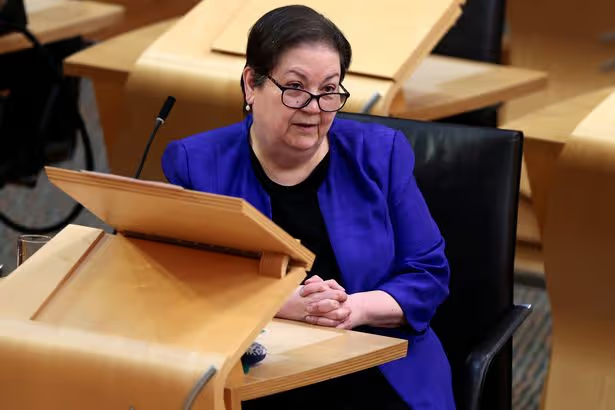
First Minister John Swinney, Tory leader Russell Findlay and Dumbarton MSP Jackie Baillie.
by BILL HEANEY
Scots must change and challenge the attitudes and behaviours that underpin and lead to violence, including the sexism, misogyny, and toxic masculinity that are prevalent in society, especially online, First Minister John Swinney told the parliament in Edinburgh today.
He was leading a debate on preventing violence against women for an equally safe Scotland.
He told MSPs: “In recent weeks, I met with victims/survivors such as Danielle MacDonald, a survivor of domestic abuse who now campaigns for change, and with Ann Grant, whose daughter Stacy Hunter was tragically murdered by her estranged husband. I was deeply affected by their stories, by the unconscionable things that they went through at the hands of their former partners and by their courage and resilience. I have made it my priority to meet with other victim/survivors and with organisations such as Rape Crisis Scotland, Scottish Women’s Aid and Engender.
“I heard directly from survivors, their families and support groups so that I could better understand their experience and learn what more we can do as a Government and, importantly, as a society, to combat violence against women and girls, which, this summer, I called an epidemic of violence.”
The First Minister said he had the privilege of engaging with survivors of violence against women and girls and representatives of the Sunday Post’s It’s Time campaign, at the invitation of Russell Findlay, leader of the Scottish Conservatives.
He added: “I do this both as First Minister and as a man, because it is men who commit this violence and it is men whose behaviour needs to change.
“We can address areas of criminal justice, but we need also to address the fundamental issues that underpin some men’s abuse of women, control of women and atrocities against women.
“In online spaces and on social media, unacceptable views—even abhorrent—in the mainstream and in our communities are given a platform and an audience. With the help of algorithms, echo chambers and bad-faith actors, and in the utter absence of regulation, those views are amplified. They are made easy to access, forever within reach through computers and the phones in people’s pockets, alongside an endless supply of nasty rhetoric, exploitative images and pornographic content.
 “In such an environment, it is easy for men and boys—some of whom are impressionable, isolated, angry, scared or vulnerable in any number of ways—to be saturated by cognitive distortions and misogynistic rhetoric, and not to see a counter or an alternative to that.
“In that way, violent, abusive and abhorrent behaviour can feel justified and normalised. However, it is not justifiable, it is not the norm, and it never will be. I cannot stress that point enough to Parliament today.
“What I say today is not to vilify men or boys. It is to recognise the extent to which certain arenas, such as the manosphere and accessible pornography, have warped views and attitudes in disturbing and profoundly harmful ways. It is to recognise the impact that those attitudes are having on our society and our culture—impacts that lead to violent, exploitative and abusive behaviours, with very real and dangerous consequences for women and girls.
“It is to recognise the challenge that we, as a society, have in adapting to new threats in a quickly changing, increasingly online world, and to recognise what we are up against…
“My Government and I unequivocally and emphatically condemn violence against women and girls in all its forms, and we want to change and challenge the behaviours that underpin it in our society. That is what my motion states. I thank those party leaders who have joined me in signing it to show with one voice that it is up to all of us as a society to challenge the distortions, the warped views, the manosphere and the misogyny that perpetuate violence against women and girls. It is up to all of us to challenge the view held by some that violence against women and girls is somehow inevitable or excusable. It is not inevitable, and it is never excusable.”
“Jackie Baillie has made the important point that the Labour Party has pressed us to take further action.”
All things being equal, he said, the Government could take up the suggestion of introducing a GPS (electronic tagging) pilot.
“I expect that we can start the pilot on the GPS arrangements by the new year,” he told the chamber.
The First Minister added: “The purpose of my intervention, however, is also to say to Jackie Baillie that I recognise the importance of the Opposition challenging the Government to ensure that we take the necessary and appropriate action. I hope that our response on GPS indicates our willingness to accept that challenge.”
“The Government is right to call for action to tackle the pervasive influence of misogyny and sexism among men and boys. Behavioural and cultural changes are important. However, we cannot ignore the need for clear and practical action. It is time to move beyond the rhetoric and focus on action.
“The Women’s Rights Network Scotland has issued two reports on sexual assaults in our national health service, and there has been no change. We now also have a new report on sexual assaults in our leisure centres. The record of the Government is not good enough and, clearly, more needs to be done.
“Since 2022, sexual crimes are up by 11 per cent, reports of rape and attempted rape are up by 32 per cent and domestic abuse crimes have rocketed by 81 per cent, and all while rape victims must wait for an average of nearly three years between reporting an incident to the police and a verdict being given. Now, rape crisis centres report that they have insufficient resources to meet increasing demand, so much so that they have had to close their waiting lists!”
“I do not doubt for a moment the First Minister’s sincere commitment to protecting women and girls across Scotland, but we will never get anywhere near to fixing the issue if we do not appreciate the scale of the problem. That is why work to tackle cultural attitudes among men and boys is necessary, but also why it is only one part of what must be a multifaceted approach to tackling the issue.
“Scottish Labour has outlined several policies that we believe would go some way to tackling the crisis that is before us. Beyond the swift implementation of GPS tracking, we would like a misogyny reduction unit; a public health approach to the crisis; the boosting of the early uptake of the equally safe at school programme, to tackle sexual harassment and gendered violence in schools, with a focus on positive male role models; the modernisation of the victim notification scheme, so that no woman who has been the victim of male violence will be left in the dark; police being back on the beat, keeping women and girls safe in all our communities; more police; the better education of men and boys; zero tolerance for gendered violence; and a clear campaign to tackle misogyny head-on.”
“I also thank Marion Scott for her campaigning journalism and for leading the It’s Time campaign on behalf of The Sunday Post. A few weeks ago, John Swinney told The Sunday Post that he had seen headlines about four horrific cases, which, he said, “stopped me in my tracks. That day, I made tackling violence against women and girls one of my highest priorities as First Minister.”
“We have all become used to similar lurid headlines—not just four or dozens but hundreds, and not over just one summer but for years and decades. I have been raising some of those cases in the Parliament for six years—accounts of depraved, cruel and sickening violence. Inadequate, cowardly men are responsible, but far too often, the justice system fails victims.
“I have spoken about the horrific case of the murder of Esther Brown—a kind and decent soul, who was raped and murdered in her own home. Esther’s murder was wholly preventable, but a review of her case said that it was not. That was a whitewash, which is typical of a culture in which no one is held to account.
“My focus today is on the continued failings of Scotland’s justice system and how it must be improved. In the past, I have spoken about secretive plea deals, through which criminals benefit from watered-down or deleted charges—often in defiance of clear, hard evidence. Working with Liz Shanks, a firefighter, we have tried to bring some transparency to that practice.
“I have also spoken about the broken bail system. Twenty-eight-year-old Claire Inglis was murdered by her partner. The authorities knew that he was a risk to her and her child, but he was bailed repeatedly. Claire’s parents, Fiona and Ian, came to First Minister’s question time on three occasions when I raised their ordeal. We then met John Swinney. All they want is answers to basic questions. Almost five years since their daughter’s murder, they are still being kept in the dark. Fiona asked me this week, “Are they waiting for us to die?”
“The Government weakened bail laws in 2023 by removing a specific presumption against bail for domestic and sexual violence. It did so despite Victim Support Scotland, Scottish Women’s Aid and others warning that doing so presents a serious risk to the safety of female victims. This summer, two women—Stacy Hunter, aged 35, and Samantha Lee, aged 54—were murdered by male partners who had already attacked them, only to be given bail. Dangerous men, freed to kill.”
“One other common theme is not so much the granting or refusing of bail, but the flagrant breach of bail laws. Often, nothing happens when conditions are breached. According to a recent report by HM Inspectorate of Prosecution in Scotland, victims explained that ‘breaches of bail are not taken seriously by the justice system’.
“They described a culture of ‘no consequences’. The perpetrators know that, so let us fix bail laws and enforce them.
“The police are not to blame. They are run ragged, and the creation of Police Scotland has removed hundreds of millions of pounds from policing budgets. The Scottish Police Federation blames that for a lack of training for officers.
“The Scottish Prison Service is not to blame, either. It is the Government’s responsibility to build sufficient prison capacity. It is outrageous that the SNP’s delayed new net zero prison in Glasgow will cost at least a billion pounds. For 20 years, the Scottish National Party Government has failed to modernise the justice system. It has failed to ensure that judges have a genuine alternative to custody. It has failed to use new technology that is being used elsewhere in Britain and to provide meaningful rehabilitation to stop reoffending, and now it is planning to free all long-term prisoners early after they serve just two-thirds of their sentence. The Government knows what the consequences of that will be. Judges have criticised the early release plan, raising public safety concerns and warning about further harming fragile trust in the justice system. I say to John Swinney: take the dangerous automatic early release plan off the table.
“My party has also campaigned to scrap guidelines not to jail criminals aged under 25. The justification for those guidelines is that such criminals are not fully responsible for their actions. Rhys Bennett raped and battered Jill Barclay, aged 47. He set fire to her while she was still alive. The judge described her murder as medieval but, because her killer was 23 years old, he was given a reduced sentence. That is sickening and obscene.
“Like Jackie Baillie, I do not question John Swinney’s sincerity. On this issue, there is much that we agree on. However, I question his Government’s policies and its record.
“Let us address the behaviour of young men. If we cannot drain the social media swamp, let us protect children from it. Let us warn children about the toxic attitudes of dangerous online clowns such as the Tate brothers, but also, or rather especially, let us fix Scotland’s criminal justice system. Bold, effective and immediate action is needed now. The tragic headlines might never stop, but they can be reduced.”