


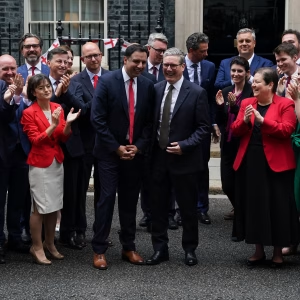
Delighted Labour MPs with Sir Keir Starmer, flanked by Dumbarton MSP Jackie Baillie and Anas Sarwar, the Labour leader in Scotland, outside 10 Downing Street.
By Democrat reporter
Sir Keir Starmer is set to face the first major rebellion of his premiership next week over the two-child benefit cap after new data released today showed the number of children affected by the contentious policy increased by 8.5 per cent.
Labour MP Kim Johnson is planning to table an amendment to Starmer’s inaugural King’s Speech on Wednesday calling for the cap to be lifted.
“This policy is cruel, punitive and is pushing struggling families into further poverty,” she wrote on X.
Former shadow chancellor John McDonnell also threatened to table an amendment on Wednesday if his party did not shift its position.
Scottish Labour’s leader Anas Sarwar and deputy leader Jackie Baillie, the Dumbarton MSP, who were pictured with Sir Keir outside 10 Downing Street after the election disagree with the Prime Minister’s stance on this policy.
As do scores of MPs who are expected to back Johnson’s motion if it goes ahead, including newly elected Labour members.
Both the Scottish National party and Liberal Democrats vowed to scrap the cap in their manifestos and would probably vote in favour.
Although it is unlikely the amendment will pass, if it goes ahead it would present the first major test to Starmer’s authority and provide an early indication of political dividing lines among the 411 Labour MPs.
The policy, which restricts child welfare payments to the first two children in most families, affected a record 1.6mn children in the year to April 2024, up from 1.5mn, according to data released on Thursday from HM Revenue & Customs and the Department for Work and Pensions.
 Starmer has refused to commit to ending the policy despite significant pressure from figures inside his party, including former prime minister Gordon Brown, left, who point to data showing it as the primary driver of the UK’s rising child poverty rates.
Johnson plans talks with Labour frontbenchers on Friday to understand whether they may be willing to shift their policy ahead of the King’s Speech.
She then intends to lay an early day motion on Monday to gauge the level of support for her intervention among MPs.
The policy was introduced by the Conservative government in April 2017, who said it would force families living on benefits to face the “same financial choices” as working families.
But there is scant evidence that it has reduced the number of parents on benefits having three or more children.
Children’s charities called for the policy to be scrapped following the publication of the new figures.
“We know that the two-child limit is a failing policy that actively pushes families into poverty,” said Joseph Howes, chair of the End Child Poverty UK umbrella group.
He added that scrapping the policy would move “the needle on child poverty overnight”.
 Labour has committed in its manifesto to a review of the UK’s universal credit welfare system, but has not guaranteed it will abolish a policy that deputy prime minister Angela Rayner, right, said in 2020 was “obscene and inhumane”.
Removing the two-child cap would cost £3.4bn a year, according to the Institute for Fiscal Studies think-tank.
About 25 per cent of children in 2022-23 were living below the poverty line up from 23.8 per cent the previous year, the largest annual increase since records began in 1994-95, according to government statistics.
The poverty line is defined as 60 per cent of average inflation-adjusted income in 2010-11.
The number of families affected by the policy, which applies to children born after April 2017, will continue to rise during this parliament as more children are born into households of three or more children.
The Resolution Foundation think-tank projects that 750,000 families will be affected by 2035, when all children in families of three or more will be captured by the policy.
Torsten Bell, the former director of the Resolution Foundation who was elected as a Labour MP this month, described the policy as “immoral” in an article for The Guardian newspaper this April, arguing that it came close to creating “a poverty guarantee”.
Work and pensions secretary Liz Kendall said: “Too many children are growing up in poverty and this is a stain on our society. “We will work to give every child the best start in life by delivering our manifesto commitment to implement an ambitious strategy to reduce child poverty. “I will hold critical meetings with charities and experts next week to get this urgent work under way.”