


Scottish Government doesn’t publish accurate exam results figures as it uses a percentage of those who actually sit the exam, rather than all those who took the class — claim
September 3, 2026
by Democrat reporter
Scotland’s REAL exam results have been published, after the SNP used a different measure to “sweep the realities” of how poor schools are performing.
And they show that exam rates are still down substantially on pre-Covid (2019) with “concerning” pass rates in English and Maths.
But the SNP are claimed to have fiddled the figures by including the percentage of passes who actually sit the exam, rather than the full class, including those who didn’t sit it. These were revealed by the Commission on School Reform, the education arm of think tank Enlighten, which only received them following a freedom of information request.
It shows the “real” pass rates for National 5 exams in Scotland. The data revealed that less than 40% of S4 pupils achieved an A-C grade in National 5 Mathematics, with A-C pass rates in the sciences down in the twenties or teens. Less than two in five pupils are passing both English and Maths.
The figures show:
- 39.7% got A-C in Maths
- Biology (26%), Chemistry (21%), Physics (18%)
- 78.3% of S4 pupils achieved A-C in English National 5
- 38.9% got A-C in both English and Maths
- 70.6% achieving an A–C pass rate in Maths
- Biology (67.1%), Chemistry (79.1%), Physics (73.2%)
- 87.2%% of S4 pupils achieved A-C in English National 5
The FOI data analyses the SQA examination data based on the number of pupils in the cohort, rather than how many sat the exam, giving a more accurate interpretation of the performance of school pupils as a whole. For example, if 100 pupils sit National 5 Maths and 90 pass, the Scottish Government would consider this to be a pass rate of 90%. This is not untrue, but it does not paint an accurate picture of overall pupil attainment.
For instance, if the total number of pupils was actually 200, and only 100 sit the exam, the overall proportion of the cohort qualifying is only 45%. Figures are all down on 2019, pre-Covid, as the SNP continues to fail pupils across Scotland:
- 39.7% in mathematics (44.5% in 2019)
- 26.2% in biology (29.4% in 2019)
- 21.3% in chemistry (25.1% in 2019)
- 17.9% in physics (20.1% in 2019)
- 8.8% in computing science (9.3% in 2019)
Carole Ford, former Headteacher of Kilmarnock Academy, former Principal Teacher of Maths, and member of the Commission on School Reform, said: “These STEM results should be of deep concern to all of us. We are talking here about a generation of children whose outcomes have been suppressed because there is no national push towards academic excellence.
“Most exam data is presented by the Government as a success, but that is based on those who take the exam. This is much more revealing and accurate data, because it measures all pupils, not just those who sit the examination. We must stop sweeping the realities of school performance under the carpet. We have an obligation to ourselves and to future generations to face up to our problems.”

She said: “The introduction of the Nat 5 Applications of Mathematics qualification is a way to ensure that some people who are not able to achieve a pass at the maths examination are able to get some sort of numeracy qualification, but it is important to recognise that the Applications course is not even close to the mathematical level of Nat 5 Mathematics, neither in content nor in level of challenge.
“For example, despite ‘mathematics’ remaining in its title, the course contains no algebra, no reference to equations or functions, no trigonometry, no geometry related to angles, straight lines, similarity or vectors.”
 Scottish Conservative education spokeswoman, Meghan Gallacher MSP said: “This blows apart the SNP’s belief that Scotland’s education system is performing well.
“This is a damning indictment of an education system that continues to slide on the SNP’s watch, with the poverty-related attainment gap still stubbornly wide. After 19 years in power, SNP ministers have run out of people to blame and excuses to hide behind. Parents and pupils deserve the truth, not more SNP spin, and ministers must urgently get a grip on standards before another generation is failed.”
The initial report based on Ms McAllan’s figures appears below …
Scottish exam pass rates rise as students find out results

Two pupils react with shock after learning their exam results in Ardrossan
By Paul O’Hare, of BBC Scotland News
More than 148,000 learners have been finding out the results of their Nationals, Highers, Advanced Highers and Skills for Work Awards.
Qualifications Scotland – which replaced the Scottish Qualifications Authority last year after several controversies – said a record number of vocational and technical qualifications were awarded.
Figures show that the poverty-related attainment gap has narrowed compared with last year.
Admissions service UCAS said a record number of Scottish students aged 18 and under had been accepted into university or college. In total, 32,370 Scottish students of all ages secured places, up from 31,850 in 2025.
She added: “These are incredibly positive results across the board, with academic passes up at every level as well as record numbers of vocational qualifications.
“This is testament to the breadth and strength of Scotland’s education system, the professionalism of our teachers and school staff and the hard work of our young people.”
Statistics showed the National 5 pass rate had risen by 0.8% in 2025 to 79.2% this year.
The pass rate for Highers was up 0.8% to 76.7% while Advanced Highers rose by 0.9% to 77.6%.
A record total of 120,485 vocational and technical qualifications were achieved at levels 1-6, an increase of 9.1% compared to 2025.
More than 131,000 people sat exams in over 460 schools, colleges and training centres this year.
The attainment gap between the results achieved by students in the least deprived parts of Scotland and those in the most deprived closed a little in this year’s figures – but still remains significant.
At Nat 5, the gap is 15.6 percentage points, down from 16.4%. The gap is the difference between the 86.6% of better-off students who got A to C grades this year, compared to 71% of those in the most deprived areas.
At Higher, the gap is 15.9 percentage points, down from 16.8 last year, and at Advanced Higher it is 12.1, down from 13.3.
Donna Stewart, chief qualifications and examinations officer, praised learners for their hard work and commitment.
“The rise in overall attainment at all three National Qualification levels and the increasing attainment in vocational and technical qualifications will rightly be welcomed in classrooms and staff rooms across Scotland,” she said.
“The diversity of qualifications being achieved today is evidence of the appetite for skills-based, practical qualifications along with traditional subjects.”
Opposition politicians said more needed to be done to improve outcomes for young people.
Scottish Labour’s education spokeswoman Katherine Sangster welcomed the improvement in results, but said there was “no room for complacency”.
“No child should be held back by their postcode or their background, but it’s clear far more must be done to tackle the damaging inequalities in our education system,” she said.
Scottish Conservative MP Andrew Bowie said “plummeting teacher numbers and spiralling levels of school violence” had made it a difficult year for pupils.
He added: “This has created a challenging environment for pupils to get the grades they hoped for, which is why they deserve a huge amount of credit for achieving great results.
“However, it’s clear some pupils are still facing a postcode lottery when it comes to educational achievement.”
The Scottish Greens called for “high-stakes exams” to be replaced with continuous assessment.
Laura Moodie, the party’s education spokeswoman, said: “We need an education system that recognises achievement throughout the year, not just on exam day.”
Scottish Liberal Democrat education spokesperson Duncan Dunlop said: “The new education secretary needs to address the teacher job mismatch, make sure kids are learning skills that equip them for the future and finally deliver on efforts to tackle the poverty-related attainment gap.”

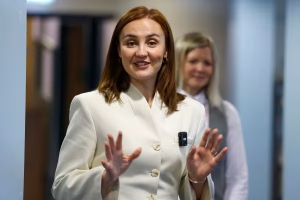
Education Secretary Màiri McAllan met students as they received their exam results.
The Educational Institute of Scotland (EIS), the country’s largest teaching union, said the results were “testament to the hard work of learners and their teachers alike”.
General secretary Andrea Bradley said: “They should all be proud of their achievements, and we should all be equally proud of them for their hard work and the results that they have achieved.”
She added that the “persistence” of the attainment gap was “a huge concern as well as a huge challenge”.
This year’s exam results are the first under Scotland’s new exams body, Qualifications Scotland.
The organisation replaced the Scottish Qualifications Authority, which was scrapped after a series of controversies, including the downgrading of some students during the Covid pandemic.