


Just how bad are the NHS statistics for Public Health in Scotland?
Dumbarton’s MSP laid them out for all the world to see following the Labour Party conference in Liverpool over the holiday weekend.
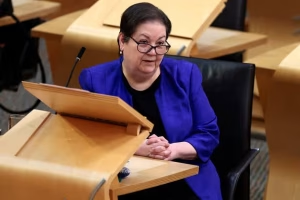 On Cancer waiting times, the Scottish Labour health spokesperson Jackie Baillie, right, said: “It is utterly appalling that neither the 31-day nor the 62-day cancer treatment standards are being met nationally, with not a single health board meeting the latter.
“Swift cancer treatment can be lifesaving, but far too many people are missing out on the urgent care they need.
“For years, we have heard the same promises from SNP ministers; targets are still not being met, despite the tireless efforts of hardworking NHS staff.
“Cancer is Scotland’s biggest killer, and we urgently need a long-term plan from the Health Secretary to get services back on track.
“Scottish Labour has called for an expansion of Rapid Cancer Diagnostic Services, improved screening, and greater investment in cutting-edge technology to help ease pressure on services and speed up treatment.
“The Scottish Government should assess these proposals and consider what steps can be taken swiftly to ensure that Scotland can finally meet cancer treatment targets.”
A&E waiting times
Jackie Baillie said: “It is clear that far too many people in Scotland are still waiting far too long in A&E, with just 61.3 per cent of patients seen and either admitted, transferred, or discharged within the Government’s four-hour target.
 “Patients are waiting in pain, while hardworking staff in our hospitals, such as the nurse pictured left after an exhausting shift, are facing burnout due to rising demands.
“The SNP’s pre-election sticking plaster solutions are falling apart. What we need is a real plan for the future that addresses the roots of this issue.
“That includes driving down waiting lists by using capacity wherever it is available, ending corridor care by improving patient flow through the hospitals, and speeding up ambulance response times.
“SNP ministers have passed the buck on our NHS for too long. Patients deserve better, and they need solutions now, not down the line.”
On Waiting Lists, Jackie Baillie said: “These dire statistics show outpatient waiting lists have climbed for the fifth month in a row.
“It is unacceptable that thousands of patients are languishing on NHS waiting lists for treatment, too many of whom are still waiting years.
“We need urgent action to cut waiting lists, not more soundbites from SNP ministers who fail to take the steps required to tackle this problem.
“The SNP must wake up to this crisis and set out a real plan to reduce waiting lists and give patients an NHS they can rely on.”
On Social care assessment, Jackie Baillie said: “Thousands of people in Scotland are stuck waiting on social care assessments or packages.
“The truth is that social care is at breaking point, piling pressure on our NHS and Scots being left in limbo as they wait for the support they need to live their lives.
“We will never fix the chaos in our NHS without dealing with the crisis in our social care. That is why this SNP government must properly support social care services, including by delivering fair pay and conditions for workers.”
Stage of treatment
- At 31 August 2026, there were an estimated 588,073 individuals on at least one new outpatient, inpatient or day case waiting list. This is equivalent to around 1 in 9 of Scotland’s population (mid-2025 estimates). Within this total, 459,343 individuals were estimated to be waiting for a new outpatient appointment, and 151,604 for an inpatient or day case admission.
- New outpatient national standard – 95% of new outpatients should wait no longer than 12 weeks from referral to being seen
- There were 107,785 attendances at a new outpatient clinic during August 2026, an increase of 4.1% from the previous month, and a decrease of 0.1% compared to August 2025. In August 2026, 62.8% of these waits were completed in 12 weeks or less, down from 65.9% in July.
- As of 31 August 2026, the number of ongoing waits for an appointment was 506,512, marking an increase for the fifth consecutive month, up 0.1% from the end of the previous month. The list size is, however, 11.1% lower compared to 31 August 2025.
- There were 14,116 waits over 52 weeks as of 31 August 2026, down 858 from July. This decrease follows an increase between the end of June and July 2026 and is consistent with the general reduction in waits over 52 weeks seen over the past year. Of those waiting over one year, 1,215 waits had exceeded two years, an increase of 33 since the end of July.
Care at home statistics
- The estimated number of people who received care at home support in 2024/25 was 97,965.
- The estimated number of hours of care at home received in 2024/25 was just under 39.2 million. Note: this figure excludes hours for Aberdeen City due to data quality issues. Therefore, the estimated number of hours of care at home will underestimate the true Scotland figure.
- There were 90% of people receiving care at home services in January – March 2025 who received personal care.
- During January – March 2025, of the care at home support funded by the local authorities, the private sector provided half of the Care at home services (50%), followed by local authorities (41%) and the third sector (8%).
- In 2024/25, of the people receiving care at home, 57% also had a community alarm and/or telecare.
- In 2024/25, there were just under 35% of people who received care at home who required at least one attendance at A&E whilst just under 34% required at least one emergency admission to hospital. This analysis is based on people whose care at home record included a Community Health Index (CHI) number, which is required to link social care and health records.
- In January – March 2025, people living in communities in the two most deprived quintiles (as measured using the Scottish Index of Multiple Deprivation) had the highest level of support through care at home with 17,540 people in deprivation quintile 1 and 17,665 people in deprivation quintile 2. This compares to 10,205 people living in the 20% least deprived communities (deprivation quintile 5). This pattern is consistent across most of the reported years (2019/20–2024/25).
Social care assessment and care at home services
- The number of people in Scotland (All Areas Submitted) waiting on a social care assessment for a package of care was 6,644 on 7 September 2026.
- The number of people in Scotland (All Areas Submitted) assessed and waiting for a care at home package was 3,281 on 7 September 2026. This is an increase of 5% compared to the number of people waiting for a care at home package this time last year (3,124 on 1 September 2025).
- Of those people in Scotland (All Areas Submitted) waiting for care at home following an assessment of their needs, the total estimated number of weekly hours of care that they were waiting to receive was 39,291 as of 7 September 2026. This represents an increase of almost 40% from the estimated number of hours at this time last year (28,085 on 1 September 2025). Changes in the total number of hours will reflect both the number of people waiting for care and the differing level of care packages required for those waiting at each time point.
Cancer waiting times
The 62-day standard states that 95% of eligible patients should wait no longer than 62 days from urgent suspicion of cancer referral to first cancer treatment. Where the 62-day standard applied:
- There were 4,492 eligible referrals, a decrease of 3.8% from the previous quarter, but an increase of 20.7% from the quarter ending 31 December 2019, the last full quarter pre-pandemic.
- 73.6% of patients started treatment within 62 days, compared with 72.2% in the previous quarter, and 83.7% in the quarter ending 31 December 2019.
- The 62-day standard was not met by any NHS Board.
The 31-day standard states that 95% of eligible patients should wait no longer than 31 days from decision to treat to first cancer treatment.
Where the 31-day standard applied:
- There were 7,048 eligible referrals, a decrease of 2.4% from the previous quarter, but an increase of 10.3% from the quarter ending 31 December 2019.
- 94.8% of patients started treatment within 31 days, compared with 94.5% in the previous quarter, and 96.5% in the quarter ending 31 December 2019.
- The 31-day standard was met by 12 of the 15 NHS Boards.
National drug and alcohol treatment waiting times
During the quarter ending 30 June 2026:
- 11,290 referrals were made to community-based specialist drug and alcohol treatment services – broadly similar to the previous quarter (11,408). Of these, 5,452 (48.3%) were for problematic use of alcohol, 3,993 (35.4%) for problematic use of drugs, and 1,845 (16.3%) for problematic use of both alcohol and drugs.
- 7,095 referrals to community-based services started treatment – broadly similar to the previous quarter (6,937).
- Nationally, the Standard was met for referrals to community-based services, with 93.6% (6,643) of referrals starting treatment within three weeks, compared with 93.0% in the previous quarter. By substance type, the Standard was met for problematic use of drugs (96.2%), both alcohol and drugs (92.8%), and alcohol (92.1%). Two NHS Boards did not meet the Standard (NHS Highland, 89.1%, NHS Lothian, 83.4%).
- 704 referrals were made to prison-based services – a decrease of 10.5% from the previous quarter (787). Of these, 527 (74.9%) were for problematic use of drugs, 142 (20.2%) for problematic use of both alcohol and drugs, and 35 (5.0%) for problematic use of alcohol.
- 299 referrals to prison-based services started treatment – an increase from the previous quarter (293).
- Nationally, the Standard was met for referrals to prison-based services, with 94.3% (282) of referrals starting treatment within three weeks compared with 93.9% in the previous quarter. By substance type, the Standard was met for problematic use of alcohol (100%), both alcohol and drugs (97.6%) and drugs (92.3%). One of the nine NHS Boards with prison-based services did not meet the standard (NHS Tayside, 71.0%). Data from prison-based services in NHS Lanarkshire have been excluded from this release.
As of 30 June 2026:
- 2,288 community-based service referrals had not started treatment. Of these, 359 (15.6%) involved a wait of more than three weeks.
- 39 prison-based service referrals had not started treatment. Of these, 15 (38.4%) involved a wait of more than three weeks.