JUSTICE: Thin blue line becoming thinner and Scottish prisons are bursting at the seams

by BILL HEANEY

They used to be known as vigilantes, but in these turbulent times we are now dealing with the Scottish Government, which would rather they were known as community police officers.

It was the spin doctors who twisted this, of course, to delude people into thinking they could sleep safely in their beds and that in West Dunbartonshire and Argyll we were adequately served by police officers on the streets at night, keeping us safe and free from harm.

Semper Vigilo was their motto – Always Watchful – and they were until Police Scotland was formed and their numbers were drastically cut.

Now the Scottish Government, having accepted that the national force was not such a good idea as they trumpeted widely at the time, and was purely a money-saving exercise, wants to strengthen the security of houses, homes and businesses which have been all but neglected.

Bobbies on the Beat is a concept the Government in Scotland no longer delivers.

Some of our MSPs in our Holyrood parliament are determined to bring that about though, but like most public services in Scotland,  there is not enough in the finance budget to do it.

Miles Briggs, an Edinburgh Conservative, has asked the Government what plans it has to strengthen partnerships between Police Scotland and other public sector bodies “to improve multi-agency approaches to community policing.”

The Cabinet Secretary for Justice Neil Gray predictably diverted this political “hospital pass” to anyone willing to stand up in the chamber, but no one in particular.

He should have known better.  If you want anything from this Scottish Government, then you have to do it yourself.
For the policing the public wants, they would have to get officers out of their vans and into the deprived housing schemes where most of the trouble happens.
He said: “Although operational delivery of policing, including engagement with partners, is a matter for the chief constable, I absolutely recognise that effective community policing depends on strong partnership working between Police Scotland and a range of partners, including local authorities, health services and the third sector.
“The Scottish Government supports the preventative approach to community safety, as expressed through Police Scotland’s 2030 vision, which places a strong emphasis on effective community policing, prevention and partnership.
“It highlights the importance of working with partners to tackle the causes of harm, supporting vulnerable people earlier and ensuring that individuals receive the right support from the right agency at the right time.”
But Miles Briggs MSP replied that too many police stations are closing in his constituency — and beyond. Dumbarton 
He said: “Police stations have all closed in the past few years, leaving the country with fewer police cells. If someone is arrested and needs to be detained, they have to be transported all the way to an available cell.”
Alexandria Hill Street has been closed for years, and the station at Crosslet has been earmarked for the same for much longer. Not only are the cells not fit for purpose. The place is a dump.
In West Dunbartonshire, prisoners have to be taken to Greenock, which Deputy Labour Leader Jackie Baillie has said is costly and takes police patrols away from the areas they should otherwise be covering.
Dr Briggs says the Scottish Police Authority should meet to consider an interim solution to the problem, and ensure that local police cell capacity is available to help to keep our communities safe.
Justice Minister Neil Gray ducked responsibility, saying: “The operational responsibility [for this] lies with the chief constable, who is accountable to the Scottish Police Authority. I raised the matter of custody arrangements and pressures across Scotland with the chief constable at our meeting this week— general matters across Scotland.”
He didn’t come up with any ideas that would make women feel safer walking home at night.
Meanwhile, Scottish Labour’s Monica Lennon asked what urgent action is being taken in response to reported warnings from the governor of HMP Barlinnie about overcrowding and the risk of critical failure arising from the prison’s ageing infrastructure.
Neil Gray told MSPs: “I very much recognise the challenges that are raised. Overcrowding has serious consequences for our prisons and has an impact on important rehabilitative work. I thank the governor and his prison officer staff at Barlinnie, as well as staff across the prison estate, for their work.

“We need to address the prison population question so that there is a safe and secure environment for people to live and work in.

“That is why HMP Glasgow is due to open in 2028, adding a further 357 places, and HMP Highland will add a further 107 places next year.

“We have increased capacity in the prison estate by more than 640 places over the past two or three years. More needs to be done, however, which is why we are considering further options for additional capacity, including modular accommodation.”

Labour MSP Monica Lennon said: “The Prison Officers Association Scotland published ‘Crisis Point Reached’, which contained 41 recommendations to tackle the wider prison crisis. One year on from its publication, is the cabinet secretary able to tell us how many of those recommendations have been implemented?
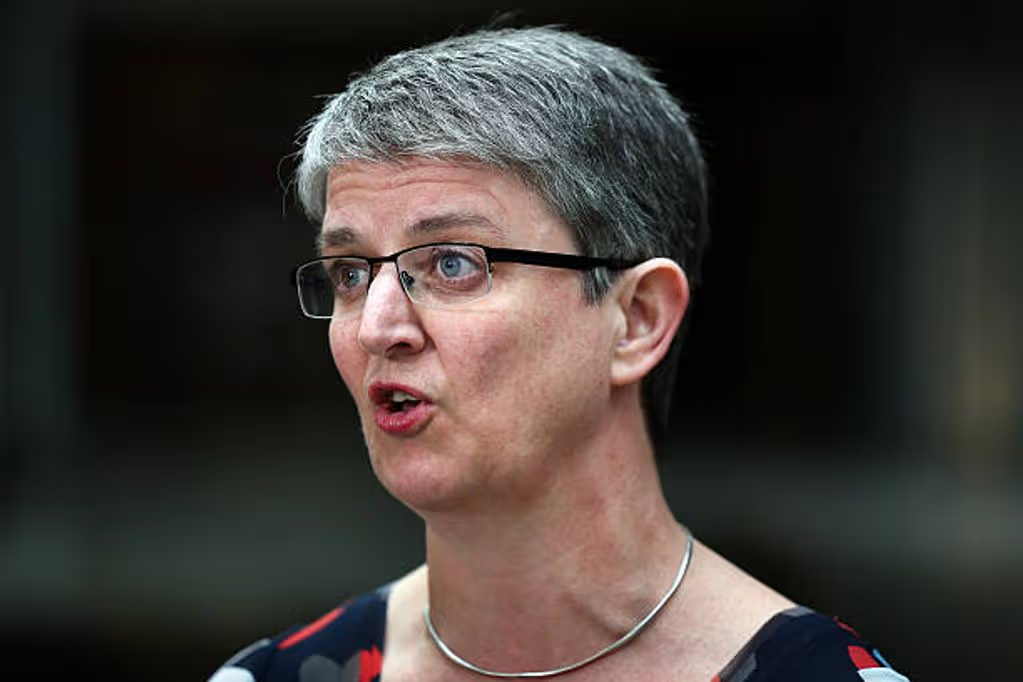
Chief Constable Jo Farrell, Labour MSP Monica Lennon, Justice Minister Neil Gray, Green MP Maggie Chapman and Conservative MSP Miles Briggs.
“Barlinnie’s governor is warning that Scotland’s largest prison ‘hangs by a thread’ right now. Given the risks to the prison staff and the prisoners in that estate, will the cabinet secretary visit Barlinnie to witness the conditions first-hand and meet staff, trade union, prisoner and family representatives?”
Neil Gray assured Monica Lennon that he had already visited Barlinnie, where he met staff, prisoners and other interested parties to discuss the challenges and the significant opportunities that come from rehabilitative work when that is possible.

He added: “Of course I recognise the challenges, and Barlinnie, given its capacity pressures and ageing infrastructure, is at the forefront of those challenges. That is why we are making the capital investment, with the replacement for Barlinnie, and considering potential further measures to create a sustainable prison population.”

Green Party MSP Maggie Chapman said the cost of building the new 1,344-place HMP Glasgow is £998 million—almost £750,000 per place—which does not include any running costs.
She added: “Given the substantial evidence that imprisonment is often not an effective crime deterrent and that the rate of re-offending after custodial sentences is more than double the rate of re-offending after community sentences, does the cabinet secretary consider that that is a wise use of public money?”
Neil Gray replied: “It is clear that there are alternatives to custody that can result in lower re-offending rates. However, I will not apologise for the fact that, when serious offences are committed that have serious consequences, including serious sentences, and for public safety, we need to have a prison estate that is fit for the future.
“That is why the investment that we are making in HMP Glasgow, including in its ability to support an ageing population in the prison estate, is important.”
Top of page picture: Barlinnie Prison in Glasgow is being replaced for £998 million.


Leave a Reply