

by Bill Heaney
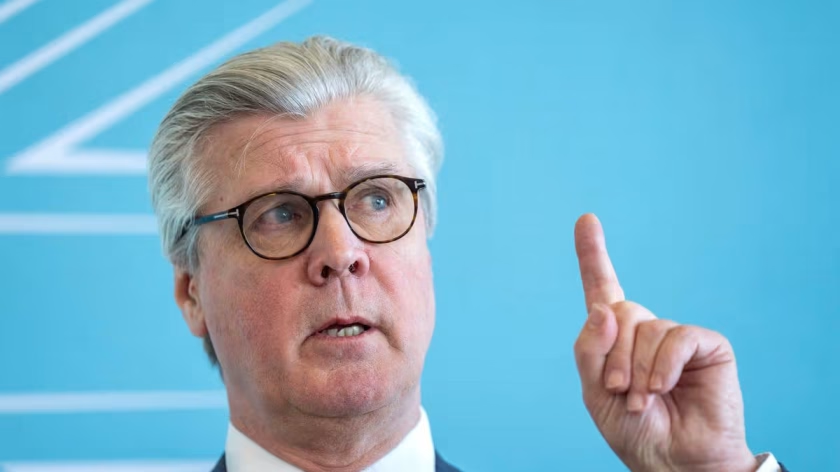
The internationally respected Institute of Chartered Accountants of Scotland has just stated that Scotland’s income tax is overly complex and is making our economy less competitive, according to Malcolm Offord, leader of Reform UK.
He told First Minister’s Questions at Holyrood today: “That mirrors Reform Scotland’s policy position as set out in our recent manifesto. Will the First Minister now graciously accept that we have won the argument on tax?”
 Stephen Flynn, pictured right, the SNP Cabinet Secretary for Economy, Tourism and Transport, and much-tipped successor to John Swinney, should the axe fall on the First Minister in the wake of the Murrell scandal, interjected: “Has Nigel Farage paid the tax on his £5 million?”
“Will the First Minister now implement Reform Scotland’s plan to cut six income tax bands to three and, further, to reduce each band by 1p below the rate in England?”
John Swinney replied: “That is a daring and bold attempt by Lord Offord to get me to accept his point of view, but I am afraid that I will resist the temptation. If I were to accept his point of view, I would have to accept swingeing cuts in public expenditure, and I have no intention of doing that.”
Malcolm Offord countered: “It is early days in the seventh session of the Holyrood Parliament, but in all the preliminary debates so far there has been one dominant theme—just referred to by the First Minister—which is the demand to spend more money.
” If the First Minister wants more money for public services, does he accept that he will raise more tax revenue if he cuts tax rates to allow the economy to grow?”
“Mr Offord is correct that these are early days in this session of Parliament. As he knows, my party’s manifesto set out a willingness to do several things on tax.
“We set out that we would not increase the rates or the number of bands, and we gave an absolute commitment that the majority of taxpayers in Scotland would pay less in taxation than taxpayers in the rest of the United Kingdom. That is our sustained position, and we must deliver that.
“We also said that, over the course of this session of Parliament, we would look for opportunities to simplify the tax system. As Mr Offord may have picked up from the comments that I made publicly at a Confederation of British Industry event a couple of weeks ago and at the Prosper conference this morning, I lay the heaviest emphasis on the importance of the Government taking measures—which we will take—to encourage and motivate growth in the economy.
” If we have a strong economy, we can have strong public services. That is the social democratic contract that I deliver to the people of Scotland.”
“Does the First Minister agree that that point proves that Scotland’s record high taxes are driving away our most talented Scots? Why on earth did she leave before at least hearing the First Minister’s cunning plan for a second independence referendum? Is it simply that she does not want to inhabit the same country as Stephen Flynn?”
Maybe for the wrong reasons but Lord Offord makes a very valid point about taxation.
Progressive taxation is good thing. And no. its not complex. What is not a good thing is taxation that is too high. And let us be clear taxation is much much more than just personal income tax. National insurance, employees and employers need to get added to the mix.
However, and this is a big however, if your economy is not working, not producing, not thriving then taxation too high is the law of diminishing returns. As an example take West Dunbartonshire Council area where fully around 20% or 1 in five people of working age is not in work but on benefits due to ill health. Its the highest in Scotland, and around 7th highest in the UK.
Factor then in the number of young people who are not in education, employment or training. That’s more folks not contributing. Then factor in young people under 18 years of age at school and the retired folks. That’s maybe around another 40% of people not working in our area. Older folks have done their bit, younger folks have still to do their bit.
So where do we sit in an area like West Dunbartonshire with around 60% of people not working. It’s a taxation nightmare. But then add in the big monster of a declining economy, with a reduced skill base and at the top big business creaming off all they can. No surprise then that we are a country in decline.
High taxes and more benefits are not the answer. Benefits and support are absolutely essential in a fair society. They are needed. But we need to produce because if we don’t then there is little to no money to pay for services. Scotland and the UK is caught in the grip of a neoliberal corporate elite where profits are gouged and taxes avoided in an economy in decline.
Unless and until we address these issues our standards will continue to decline. But hey, maybe folks should ask themselves why, as a comparison, Norway, a country the same size as Scotland has a immeasurably higher economic out put and standard of living.