


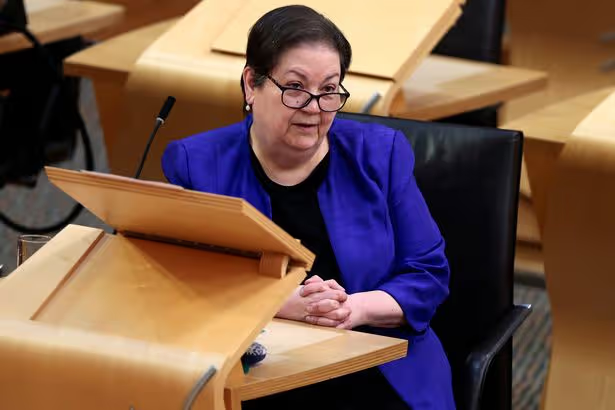

Dumbarton MSP Jackie Baillie and First Minister John Swinney.
by BILL HEANEY
Dumbarton MSP Jackie Baillie told the Scottish Parliament on Thursday that the campaign against the “dangerous downgrading of neonatal services” was represented at a meeting of the Public Petitions Committee.
She told MSPs: “Its message is clear: mothers and their children should not be put in danger due to Scottish National Party centralisation.”
She added: “That is just one example of how the SNP is failing on women’s health. Statistics show that women in Lanarkshire face waits of more than four years for hysterectomies and that thousands of women across Scotland are currently waiting more than a year for gynaecology treatment, but what was John Swinney’s answer to this crisis in women’s health?
“He scrapped the role of women’s health minister. That is simply not good enough. Does the First Minister know how long, on average, women in Scotland have to wait for an endometriosis diagnosis?”
“Women wait too long for treatment for endometriosis in Scotland, and the Government, as Jackie Baillie knows, is working very hard to ensure that waiting times are reduced so that treatment can be delivered in a credible and acceptable timescale to everyone involved, especially to women who suffer from endometriosis.”
“The Government’s miscarriage care framework states that women who are at high risk or who have complications should be able to self-refer to the early pregnancy assessment service. Why was that support not available for the woman I am talking about?”
Mr Swinney said the woman’s case was being explored. He sympathised with her — “She should not have had that experience. We will have to get to the bottom of exactly why that was the case, because it is important that when there is any vulnerability whatsoever in relation to a pregnancy, the earliest possible intervention is provided.
“That is what the maternity framework is designed to offer. It has clearly not delivered that in this case. We must understand why that is the case and provide a remedy. When things do not go as they should we should be transparent and open about that and ensure that all steps are taken to ensure that the situation is not repeated in the future.”
“However, her experience is not unique. There are lots more women in the same situation. One was pregnant following a previous miscarriage when she noticed spotting on 23 December.
“On Christmas Eve, she had to go to accident and emergency because her condition had deteriorated and there was no capacity to see her in the maternity service. While she waited anxiously for news about her baby, the staff struggled to co-ordinate with gynaecology and maternity care.
“When she finally got a scan, no heartbeat could be found. It was another seven days before her miscarriage was confirmed, and then only after she had had two further scans.
The women referred to were in the Parliament to demand change. As one has said, families should not have to endure repeated loss before their concerns are taken seriously. The framework for miscarriage care is not working. The First Minister should ensure that miscarriage care is urgently reviewed and women’s voices are heard?”
“The framework for the delivery of maternity care should address the circumstances that Ms Baillie has put to me. It has clearly not done that
“in these two cases that is very apparent. That is why the Government has commenced a series of inspections of maternity services around the country. A range of unannounced inspections is being carried out by Healthcare Improvement Scotland, and the Government receives the reports on those inspections, which lead to action points.
“Some of those reports require significant reforms and actions to be undertaken, the implementation of which the Cabinet Secretary for Health and Care is monitoring.
“We want to ensure that people get the best and most appropriate care. In the cases that Jackie Baillie has put to me today, that clearly has not happened. I apologise for that, and I will happily explore both those cases and will respond by providing as much information as I can to these women to whom I express my sympathy and empathy for what they have experienced.”